
Planting
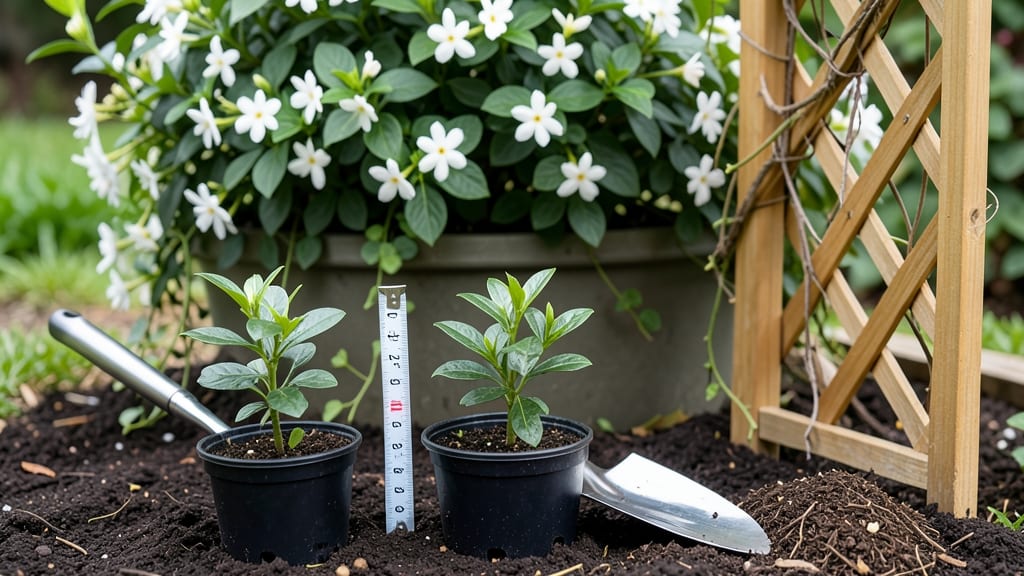
To plant star jasmine with fragrant, bushy vines, spacing is everything—3 to 5 feet apart for ground covers and 6 to 10 feet for trellised varieties ensures airflow and room to thrive.
Struggling to get your star jasmine 🌸 to spread beautifully without overcrowding? The right spacing can transform your garden into a fragrant, lush paradise—here’s the exact science behind it.
Star jasmine grows aggressively, and cramming plants too close leads to weak stems, fewer flowers, and even disease. But get the spacing right, and you’ll enjoy years of sweet blooms with minimal pruning.
Below, I break down the ideal distances for your climate, soil type, and whether you’re growing it as a ground cover or climbing a trellis—plus how to fix overcrowded spots.

Optimal star jasmine spacing for bushy growth and airflow
Star jasmine (Trachelospermum jasminoides) thrives when planted with the right spacing to encourage lush foliage and fragrant blooms. Too close, and you’ll end up with crowded vines prone to disease; too far, and your garden will look sparse.
The key lies in balancing airflow, root competition, and your plant’s mature size—typically 6 to 20 feet when trained on a trellis or allowed to trail.
For ground cover or low trellises, aim for 3 to 4 feet apart to let vines spread naturally. If you’re training them vertically on a permanent trellis or fence, space plants 4 to 6 feet apart for optimal airflow and sunlight penetration.
This spacing ensures each vine has room to climb aggressively and produce abundant flowers without competing for resources.
Your climate zone also plays a role. In hot, dry regions like USDA Zones 8–10, space vines slightly wider (5–6 feet apart) to reduce water competition and improve airflow, which cuts down on powdery mildew risks.
In humid climates (Zones 6–7), stick to the 4–5 foot range to prevent fungal issues caused by stagnant air.
Soil type matters too. In sandy soil, roots spread wider, so increase spacing to 5–6 feet to avoid root competition. In clay-heavy soil, where roots grow deeper, 3–4 feet apart works well because nutrients and moisture are retained closer to the surface.
Always amend soil with compost to improve drainage and fertility before planting.
When planting, dig a hole twice as wide as the root ball but only as deep as the container’s base. This encourages roots to spread horizontally, which is crucial for anchoring vines to trellises.
Gently loosen the root ball if it’s pot-bound, then backfill with native soil mixed with organic matter like compost or aged manure. Water deeply to settle the soil and remove air pockets.
For vertical growth, install a trellis or fence before planting so vines can climb immediately. Use soft ties or twine to guide young stems—never wire, which can damage bark.
Prune spent flowers in late summer to redirect energy into new growth rather than seed production. This keeps your star jasmine bushy and fragrant year after year.
If you’re planting multiple rows, stagger plants in a grid pattern to maximize space efficiency. This mimics natural growth habits and reduces gaps where weeds or pests might take hold.
For example, in a 3-foot spacing ground cover, arrange plants in a 3x3-foot grid for even coverage. In 5-foot spacing for trellises, use a 5x5-foot grid to maintain symmetry.
Pro tip: Plant star jasmine near complementary climbers like clematis or honeysuckle to create a layered, fragrant garden. Just ensure they have distinct trellises or support structures to avoid root tangling. The contrast in flower colors and foliage textures will elevate your garden’s visual appeal while keeping maintenance manageable.
Remember, star jasmine is a slow-to-moderate grower, so don’t rush to fill gaps. Patience pays off with vibrant blooms and lush greenery that’ll fill your garden with intoxicating fragrance by midsummer.
With the right spacing, your star jasmine will reward you with years of low-maintenance beauty and heavenly scent. 🌸
How climate and soil affect star jasmine spacing needs
Your star jasmine thrives in different climates, but spacing needs shift dramatically depending on whether you're in a hot, dry desert or a humid subtropical zone. In arid regions, plants need more room to stretch toward moisture, while humid areas demand tighter spacing for airflow to prevent fungal issues.
Let’s break down how to adjust your planting distance based on your local conditions.
The soil type also plays a crucial role. Sandy soil drains quickly, so roots spread wider to find nutrients, while clay soil holds moisture longer, allowing plants to grow more compactly.
If you’re unsure about your soil, a quick dig test can reveal whether it’s well-draining or dense—this directly impacts how far apart you should plant.
Here’s how to balance climate and soil for optimal star jasmine spacing:
Climate & Soil Spacing Guide
- Spacing: 4–6 ft apart
- Why: Roots seek moisture
- Soil Tip: Amend with compost
- Spacing: 3–4 ft apart
- Why: Prevents fungal spread
- Soil Tip: Ensure drainage
- Spacing: 5–6 ft apart
- Why: Roots spread wider
- Fix: Add organic matter
- Spacing: 3–4 ft apart
- Why: Roots stay compact
- Fix: Improve drainage
In hot, dry climates, star jasmine needs 4–6 feet between plants to avoid root competition for water. I’ve seen vines in USDA Zone 9 stretch aggressively when planted too closely, leading to weak, leggy growth.
Adding mulch helps retain moisture, but spacing is key—think of it like giving each plant its own personal water zone.
Conversely, in humid regions, 3–4 feet of space is ideal to improve air circulation and reduce powdery mildew risk.
I once grew star jasmine in Zone 8’s high humidity with 2-foot spacing, and the vines struggled with fungal spots until I pruned back and widened the gaps. Prune regularly to maintain airflow, even with tighter spacing.
For sandy soil, roots spread wider to find nutrients, so 5–6 feet of space prevents competition. I’ve amended sandy beds with compost and peat moss to help retain moisture, which lets me reduce spacing slightly to 4–5 feet.
In clay soil, roots stay compact, so 3–4 feet works well—just ensure proper drainage to avoid root rot.
Pro tip: If your soil is unknown, do a simple jar test. Fill a jar with soil and water, then shake it. If the water clears quickly, you’ve got sandy soil—space plants wider.
If it stays cloudy, you’re dealing with clay, so tighten up the spacing. Adjust as you grow—your star jasmine will thank you with healthier vines and more fragrance!