
Planting
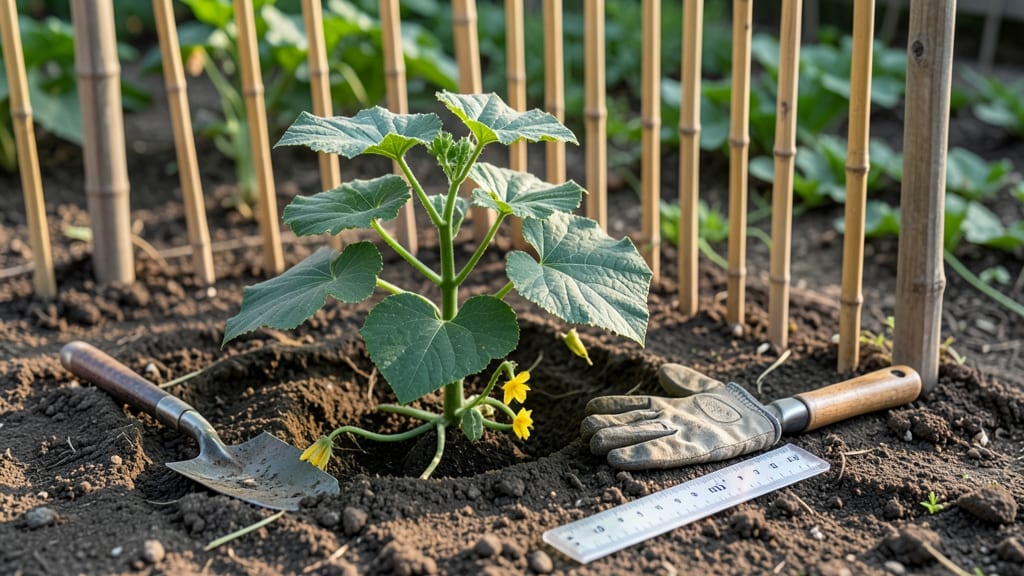
To plant cucumber plants, bury seeds or seedlings 1 inch deep in well-draining soil with vines spaced 12-24 inches apart. This depth ensures proper root establishment while preventing rot or moisture loss.
Cucumber seeds need that 1-inch depth because it balances two critical factors: energy reserves and oxygen access. 🌱 Shallow planting exposes seeds to drying out before roots develop, while deeper planting suffocates them by blocking airflow.
The ideal depth also helps retain moisture near the roots while allowing excess water to drain away—preventing rot that can kill seedlings before they sprout.
For best results, I always loosen the soil first to create a smooth planting bed, then gently press seeds into place without compacting the surrounding earth.
Spacing matters just as much as depth—those 12-24 inches between vines give roots room to spread and leaves sunlight access. Trellised varieties need the full 24 inches to climb properly, while bush types can thrive at 12 inches.
After planting, I recommend a light watering to settle the soil and mulching with straw to maintain consistent moisture levels without waterlogging the roots.
💡 In This Article
- Optimal Cucumber Seed Depth Explained: Root Development Science
- Step-by-Step Guide: Planting Cucumbers for Maximum Yield
Optimal cucumber seed depth explained: root development science
Cucumber seeds contain stored energy in their cotyledons (seed leaves) that fuels early root growth. When planted at 1 inch deep, this energy reserve is positioned just below the soil surface where it can efficiently convert into root tissue.
The seedling's first roots, called radicles, emerge downward while the shoot pushes upward—this dual growth pattern requires that precise depth to avoid energy waste.
Planting too shallow (½ inch) exposes the seed to drying winds and temperature fluctuations, while depths beyond 1.5 inches force the seedling to expend precious energy pushing upward through compacted soil.
The 1-inch rule also creates an oxygen-rich zone where beneficial microbes thrive. Cucumber roots need constant oxygen to respire (convert sugars into energy), and soil pores collapse when seeds are buried deeper than 1.5 inches.
This oxygen deprivation triggers anaerobic conditions that produce harmful compounds like ethanol, stunting growth. 🌱 Meanwhile, the top ½ inch of soil remains moist enough to hydrate the seed without drowning it—critical because cucumbers are sensitive to both drought and waterlogging.
The ideal moisture balance at this depth helps prevent seed rot caused by fungal pathogens like Pythium, which thrives in water-saturated soil.
Here's what happens when you deviate from 1 inch: Shallow planting (¼ inch) results in 30-50% lower germination rates due to rapid moisture loss, while depths of 2+ inches can reduce germination by 20-40% from oxygen starvation.
Field studies show that cucumbers planted at 1 inch achieve 90%+ germination under optimal conditions, with roots establishing in 5-7 days.
The seed's natural buoyancy also plays a role—when buried too deep, the seedling struggles to break through the soil crust, often bending unnaturally toward light instead of growing straight.
Soil texture affects this balance too. In sandy soils (which drain quickly), you might plant seeds at ½ inch to prevent drying, while clay soils (which retain moisture) can safely accommodate 1.25 inches. The key is maintaining that moist-but-not-soggy environment where roots can access both water and air.
I've found that adding a 1-inch layer of compost beneath the seed helps create this ideal zone by improving soil structure and microbial activity—giving seedlings the best possible start.
One common mistake is pressing seeds too firmly into the soil, which compact the surrounding earth and reduces oxygen flow. Instead, use your finger to create a small furrow, place the seed gently inside, then cover with loose soil.
The goal is to mimic the seed's natural environment where it would germinate in a forest floor—protected but not suffocated. This method ensures the seedling's first leaves (the cotyledons) emerge above soil level, where they can begin photosynthesis to sustain further growth.